

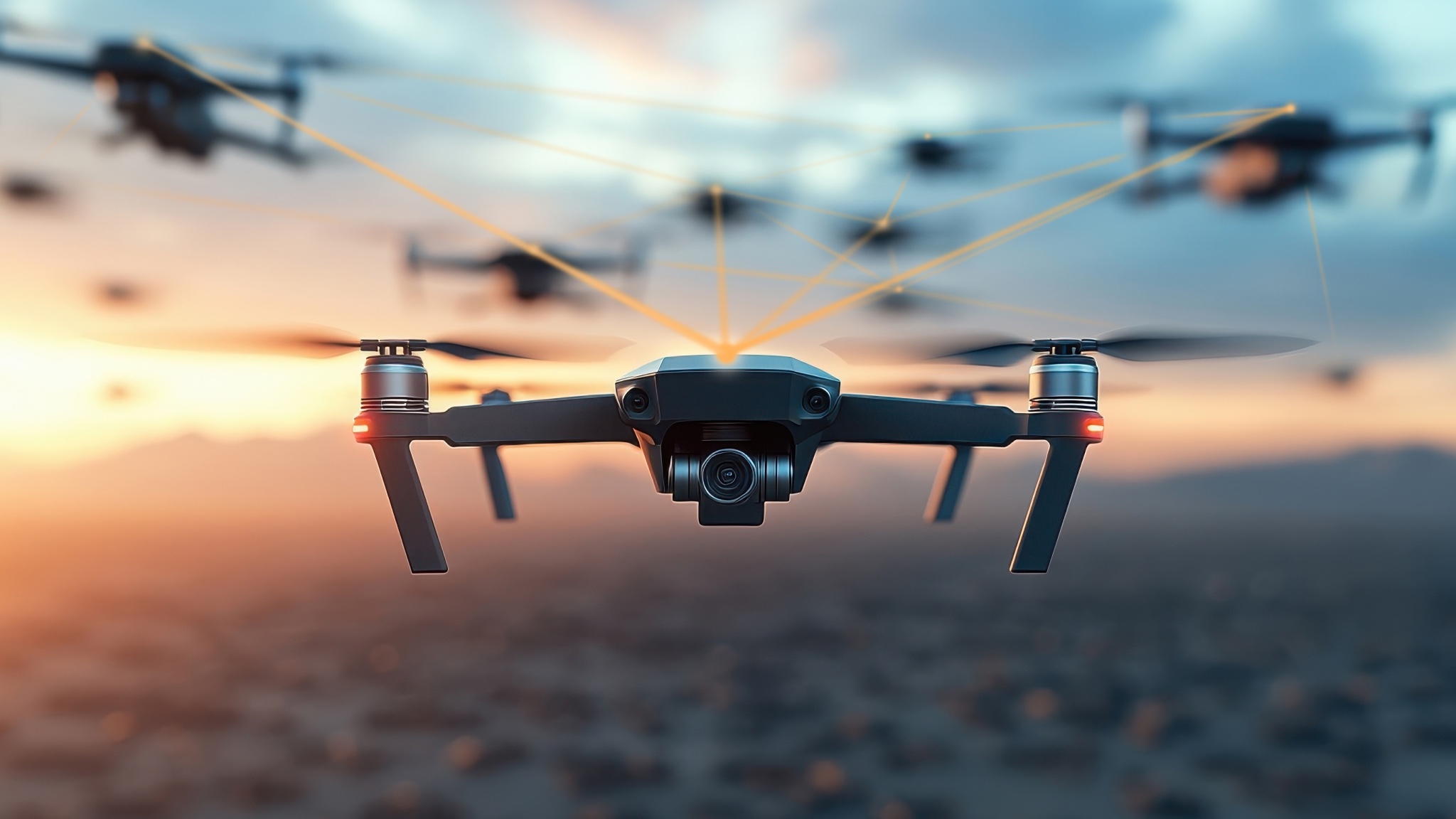
The Pentagon’s plan for U.S. drone dominance envisions masses of attritable UAVs performing every conceivable mission set in support of the warfighter. That demands global networking that can scale and connect all those devices as seamlessly as if they were in the same room — even if they’re swarming over water toward an adversary target and uploading sensor data and ISR imagery to enterprise systems.
Autonomous systems will come in a range of platforms and will rely on an array of enterprise and GCS systems. They will need simple, resilient and secure communications on multiple channels and bands. To keep abreast of innovation, they can’t be locked into vendor networking devices. And in a conflict with a peer adversary equipped with advanced electronic warfare and cyber capabilities, the network connecting those devices and systems must deliver ultra-fast failover across satellite and terrestrial links, including line-of-sight (LOS) and other ground-based channels, to maintain uninterrupted operations.
ZeroTier’s next-generation connectivity and cybersecurity handles scenarios that traditional networking struggles with: edge devices, remote industrial or IoT deployments, multi-vendor environments, userless devices, complex NAT traversal, and distributed teams, while working dynamically over different connectivity mediums.
It’s simple, resilient and secure: the strongest and most economical networking solution for the future of tactical autonomy.
If it Flies, ZeroTier Can Network it
A ZeroTier software-defined network is highly flexible, enabling the dynamic command and control architecture that autonomous missions will demand. Using ZeroTier, drone units can rapidly build a decentralized mesh network linking up the dozens or hundreds of drones envisioned in a future autonomous operation. With no appliance or control needed to handle every connection, networks running on ZeroTier’s platform grow organically.
ZeroTier assigns each device a stable identity without requiring a static IP address, reducing manual configuration and the overhead of managing address pools. Administrators can authenticate drones and add them to networks without being physically present at the endpoint if the devices have been pre-provisioned. Forward operators can do further live adjustments as needed. Policies can be applied consistently across thousands of devices, and the decentralized design avoids bottlenecks that typically limit fleet-scale environments.
Meanwhile, ZeroTier’s distributed design eliminates central bottlenecks and lets each device handle its own secure identity, routing, and link negotiation. ZeroTier’s lightweight client meets the most stringent SWAP-C requirements, and it can run on any device. Bring your favorite drone, bring your favorite operating system, and ZeroTier networks them.
ZeroTier extends device connectivity by enabling distributed coordination all the way to the edge. Each device in a swarm requires internet access to establish and maintain connectivity, but the intelligence of the network lives on the edge rather than in centralized infrastructure. Using ZeroTier’s proprietary protocol, devices form a mesh of direct, point-to-point connections with one another. If external connectivity is lost, the mesh can continue operating locally without relying on ZeroTier-hosted infrastructure. ZeroTier also seamlessly supports non-mesh configurations if such a topology is needed.
Every Comms Channel, All at Once
UASs linked in a ZeroTier mesh network broadcast on all available channels at once: LEO SATCOM, 4G-6G, line-of-sight — anything with an internet connection. ZeroTier’s network overlay is self-healing and durable for contested and denied comms environments. When one channel goes down, ZeroTier fails over to the next best channel within milliseconds.
ZeroTier removes the need for proprietary hardware, lengthy provisioning cycles, and rigid architectures. Its secure connectivity adapts to the toughest real-world UAS missions across domains: force-on-force drone combat; Intelligence, Surveillance, and Reconnaissance (ISR); close air support (CAS); medical support and casualty evacuation; asset protection; fire support; and much more. You name the mission, and ZeroTier can network it.
ZeroTier connects legacy systems, modern infrastructure, and state-of-the-art edge devices under the same policy model — a crucial capability for commands that are constantly integrating new technology into older platforms. It enables seamless interoperability with other networked systems across the Joint Force and with coalition partners.
Traffic among ZeroTier nodes is protected with AES-256-bit end-to-end encryption. Keys are established directly between peers and stored locally on the device. The system continuously validates identities and cryptographic integrity as connections form and evolve. Cracking or spoofing a drone on a ZeroTier network would be extremely difficult to do. Meanwhile, ZeroTier’s network policies can quarantine compromised drones or remove them from the mesh network.
ZeroTier is massive scale, minimal effort on any number of devices: It empowers units to spin up secure, private, and battlefield-ready networks in minutes, without buying new hardware. It works anywhere, adapts fast, and locks down comms with defense-grade encryption. Self-heal, self-host, stay air-gapped, and stay in control.
Want to learn more about how ZeroTier can enable the dynamic command and control architecture that autonomous missions demand? Request a demo today.
Looking for a deeper breakdown of the terminology? Our networking and cybersecurity glossary has you covered.