If your quantum strategy is still “wait and see,” you’re missing the immediate risk. Adversaries are already archiving your encrypted traffic today to decrypt it tomorrow, a tactic known as “harvest now, decrypt later” (HNDL).
The Department of War’s Chief Information Officer made the same case in “A Day Without Cryptography,” published for Cybersecurity Awareness Month. The piece imagines a single day without working cryptography: forged debit card transactions, tampered water, power, and fuel controls, and cars taken over remotely. The bigger loss is authentication. In the article’s words, “Systems might run, but no one could be sure who was really in control.” A cryptographically relevant quantum computer (CRQC) would make that break permanent.
This reality is driving a generational shift in the internet’s cryptographic foundation. The National Institute of Standards and Technology (NIST) finalized its first post-quantum standards in August 2024, and the deadlines built on them are now close. For infrastructure teams, the transition isn’t a routine algorithm patch. It’s a structural retooling for the future.
The New Alphabet Soup: Decoding the Standards
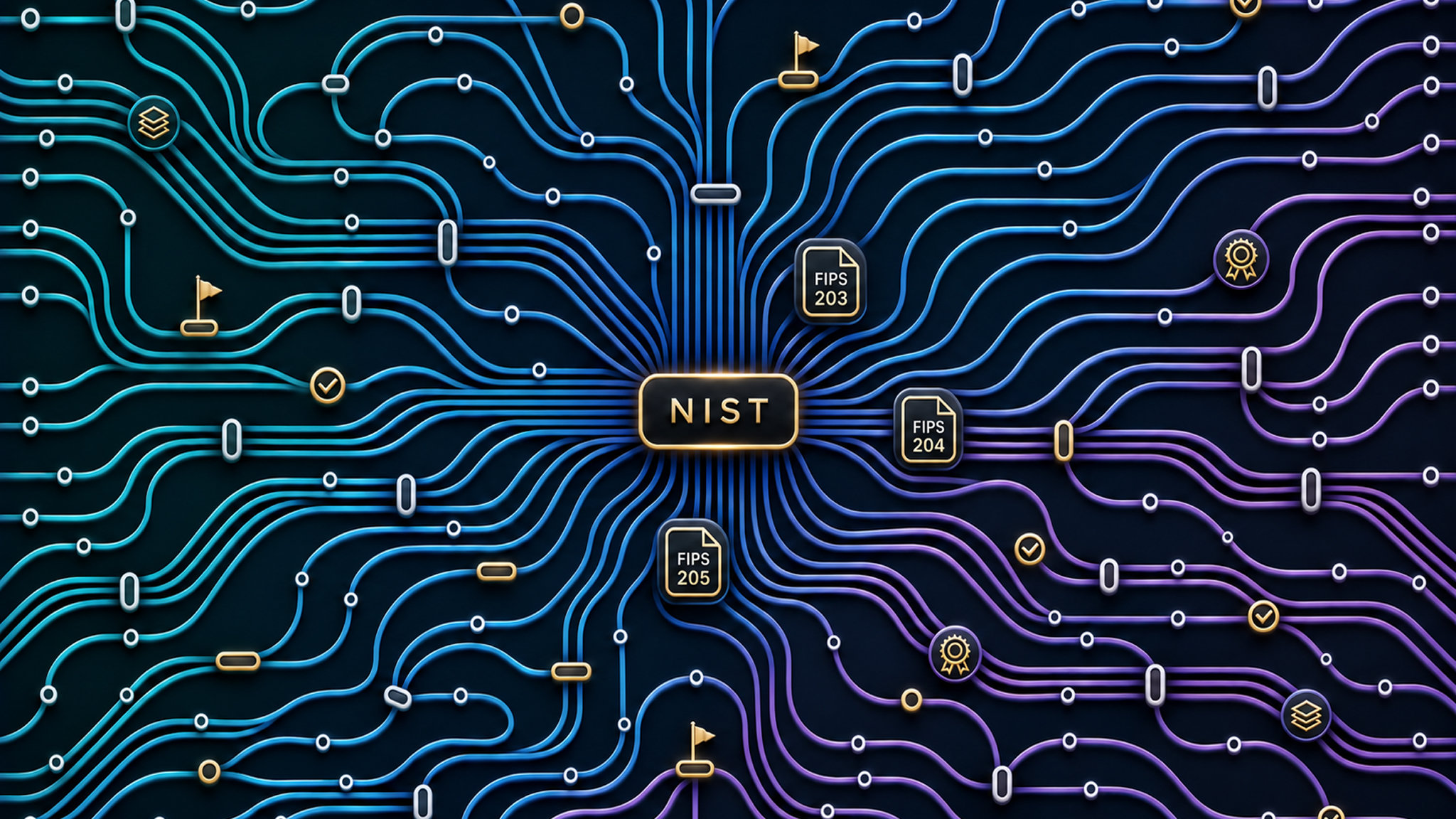
NIST’s finalized post-quantum cryptography (PQC) standards — Federal Information Processing Standards (FIPS) or FIPS 203, FIPS 204, and FIPS 205 — provide the necessary blueprints to replace vulnerable Rivest–Shamir–Adleman (RSA) and Elliptic Curve systems.
Here’s the breakdown you need:
- ML-KEM (FIPS 203): Formerly known as Kyber, the Module-Lattice-Based Key-Encapsulation Mechanism is your new best friend for key exchange. It provides a secure way to establish symmetric keys over public channels, effectively shielding your traffic from quantum-powered decryption.
- ML-DSA (FIPS 204): Derived from Dilithium, this Module-Lattice-Based Digital Signature Algorithm is designed for general-purpose digital signatures. It is the workhorse for identity verification and authentication.
- SLH-DSA (FIPS 205): Based on SPHINCS+, the Stateless Hash-Based Digital Signature Algorithm serves a critical niche. Unlike the lattice-based ML-DSA, SLH-DSA relies on the security of hash functions. It’s “stateless,” meaning you don’t have to manage a complex signature state, making it a robust, conservative fallback for digitally signing documents, where simplicity and resilience are paramount.
Compliance and CNSA 2.0
The stakes are high, especially for government, defense, and highly regulated sectors. The NSA’s Commercial National Security Algorithm Suite 2.0 (CNSA 2.0) isn’t a vague checklist. It’s a rigid timeline. And for network infrastructure, the clock is ticking. New procurements must be quantum-resistant by January 1, 2027, and networking equipment, such as VPNs and routers, must use CNSA 2.0 algorithms exclusively by 2030. The full transition is due by 2035.
CNSA 2.0 explicitly mandates the highest security tiers of NIST’s PQC standards, specifically ML-KEM-1024 and ML-DSA-87. Alongside them, it requires AES-256 and SHA-384 or SHA-512, and it doesn’t include SLH-DSA. For signing software and firmware, CNSA 2.0 specifies the stateful hash-based schemes LMS and XMSS instead.
CNSA 2.0 replaces CNSA 1.0, the suite NSA published in 2016. AES-256 and SHA-384 carry over, but CNSA 1.0’s public-key algorithms (RSA-3072, Diffie-Hellman, and ECDH and ECDSA on P-384) can’t withstand a quantum attack. CNSA 1.0 is now only a transitional suite: its algorithms stay approved until each equipment category’s CNSA 2.0 deadline, and then they’re deprecated. A product that meets CNSA 1.0 but not 2.0 will need to be upgraded or replaced before those dates.
That distinction applies to hybrid designs too. A connection that pairs ML-KEM-1024 with P-384 ECDH still depends on a CNSA 1.0 algorithm, so it doesn’t count as CNSA 2.0 exclusive. ZeroTier Quantum’s non-hybrid mode utilizes CNSA 2.0 algorithms only. That mode drops the classical P-384 pairing and runs ML-KEM-1024, ML-DSA-87, AES-256, and SHA-384 or SHA-512 on their own. Teams that need to run only CNSA 2.0 exclusively can deploy it in that configuration.
Outside of government and defense, the same algorithms are setting a new standard for enterprise security, where they go by their NIST designations, ML-KEM (FIPS 203) and ML-DSA (FIPS 204), rather than CNSA 2.0. Adopting these FIPS-approved standards isn’t about pleasing auditors. It’s about closing a massive vulnerability window opened by HNDL threats before the hardware landscape permanently shifts.
FIPS 140-3: Validating the Code That Runs the Math
FIPS 203, 204, and 205 define the algorithms. A separate standard, FIPS 140-3, covers the cryptographic modules that implement them. Under NIST’s Cryptographic Module Validation Program (CMVP), run jointly with the Canadian Centre for Cyber Security, accredited labs test a module and NIST issues a certificate. Federal agencies, FedRAMP cloud services, and defense contractors are required to use FIPS 140 validated cryptography, and many regulated industries now write the same requirement into their contracts.
FIPS 140-3 replaced FIPS 140-2, and the differences matter for anyone buying or building secure infrastructure:
- International alignment: FIPS 140-2 was a standalone U.S. specification. FIPS 140-3 is built on the international standards ISO/IEC 19790 and ISO/IEC 24759, so one set of requirements applies across markets.
- Stricter self-tests: Modules must pass pre-operational self-tests, including a software integrity check, before they perform any cryptography, plus conditional tests on each algorithm.
- Stronger authentication and attack resistance: Security Level 4 now requires multi-factor authentication, and Levels 3 and 4 must address non-invasive attacks such as timing and power-analysis side channels.
- Tighter key handling: Requirements for managing and zeroizing sensitive security parameters, including keys, are more detailed and now cover public parameters too.
- A firm deadline: FIPS 140-3 took effect in 2019, the CMVP stopped accepting new FIPS 140-2 submissions in 2021, and all remaining FIPS 140-2 certificates moved to the historical list in September 2026. Historical certificates can support existing systems but not new procurements.
Both ZeroTier One and ZeroTier Quantum are FIPS 140-3 validated. Teams with a federal, FedRAMP, or regulated-industry FIPS requirement can deploy either product today, with no need to rely on a FIPS 140-2 certificate that has already reached the historical list.
How ZeroTier Quantum Puts FIPS to Work
ZeroTier Quantum is the world’s first end-to-end quantum-secure networking platform. It uses both CNSA 2.0 algorithms and pairs each with a classical NIST P-384 counterpart as a hedge. An attacker has to break both to get in. Here’s how ZeroTier Quantum puts these cryptographic standards to work across the network stack:
- Key exchange: Every connection runs ML-KEM-1024 alongside P-384 ECDH, and both feed the session key. Each ML-KEM-1024 public key and ciphertext is 1,568 bytes, compared with 96 bytes for a P-384 public key.
- Signatures: Device identities, certificates, and network configurations are signed with both ML-DSA-87 and ECDSA P-384, and both signatures must verify. An ML-DSA-87 signature is 4,627 bytes, compared with 96 bytes for ECDSA P-384.
- Traffic: The post-quantum math runs only when a session starts or rekeys. Packets in between are encrypted with AES-256-GCM, with keys derived using HMAC-SHA-512.
ZeroTier Quantum doesn’t use SLH-DSA. Its signatures run from about 8 KB to 50 KB, which suits signing firmware better than a network handshake.
Why Your Network Stack Needs to Be Crypto-Agile
The shift to PQC isn’t a one-and-done update. ML-KEM and ML-DSA are NIST’s first post-quantum standards, not its last: HQC and FN-DSA are already on the way, and more signature schemes are still in review behind them. Supporting each new one without tearing down your entire architecture takes crypto-agility, the ability of your network stack to swap out cryptographic primitives as the standards change.
NIST selected HQC (Hamming Quasi-Cyclic), a code-based KEM, in 2025 as a backup to ML-KEM that doesn’t depend on lattice math, and its standard is due in 2027. FN-DSA, the signature scheme derived from FALCON, is next in line as FIPS 206. Behind those, NIST is still evaluating a second round of additional signature candidates, including MAYO, HAWK, and SQIsign. Any of them could become a requirement your network stack has to support, so the ability to add algorithms matters as much as the ones you deploy today.
Crypto-agility also depends on people. In the previously mentioned article, the Department of War’s PQC Directorate says the migration needs a workforce in government and industry trained to account for, manage, and maintain cryptography, and it plans to build that workforce alongside its PQC deployment.
At ZeroTier, this is our priority. Our network stack is inherently aligned with these emerging standards. Moving from classical cryptography to post-quantum readiness is complex, but our crypto-agile approach handles the heavy lifting so your team can focus on connectivity, not configuration.
In ZeroTier Quantum, agility lives in the protocol, not in a negotiation on the wire. Every handshake starts with a protocol version number, which the receiver checks before decrypting anything, and each version fixes its cipher suite. A new suite would ship as a new protocol version, so there’s no weaker option for an attacker to downgrade a connection to. Device identities also list the transport protocols they support and carry a revision number that increases each time a device rotates its keys.
The future of the network is quantum-resistant. So, now is the time to ask yourself: Is your stack ready?
Want to learn more about how ZeroTier Quantum protects your network with NIST-standardized post-quantum cryptography? Contact sales today.