
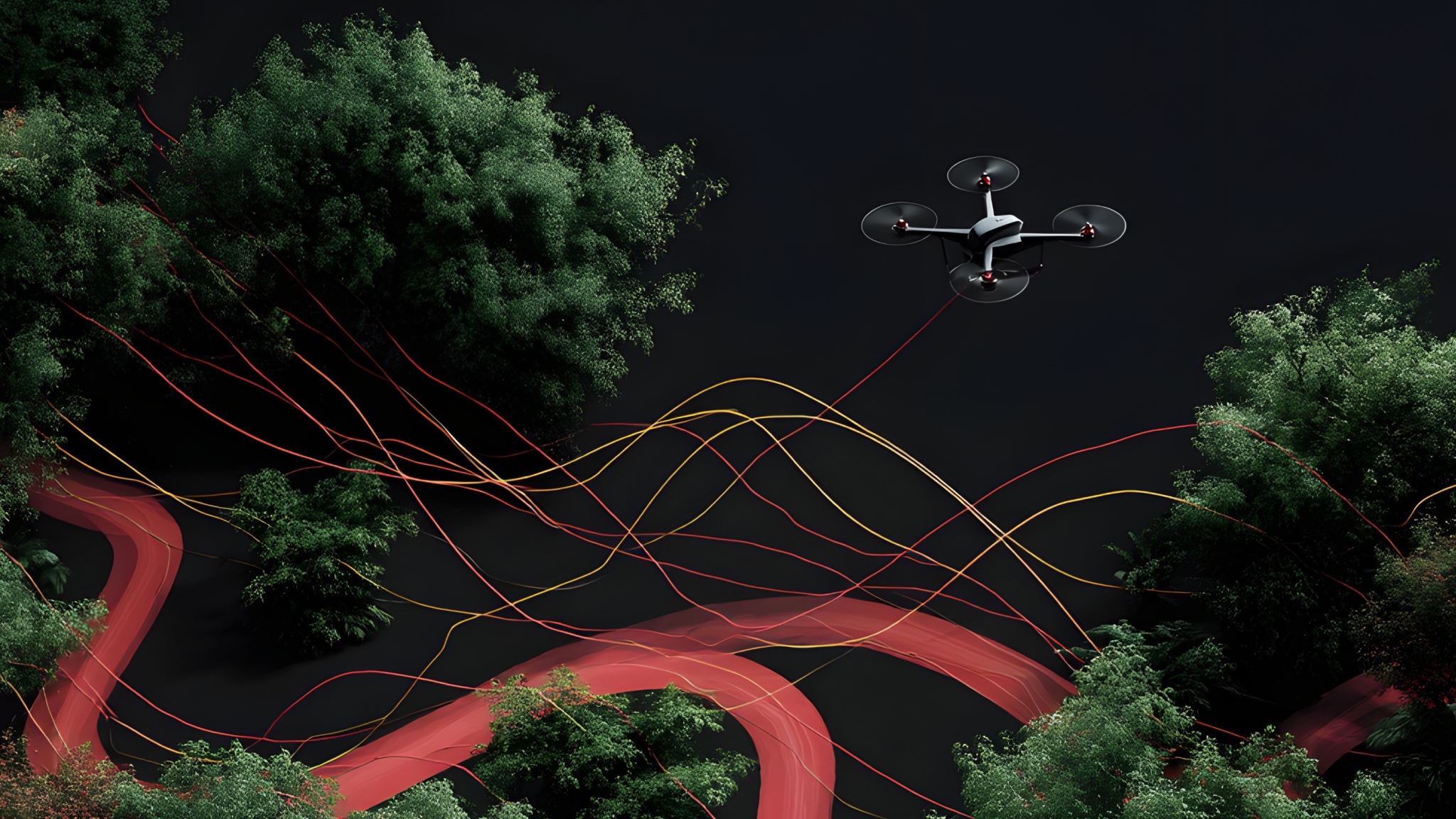
Modern drones rarely rely on one connection for an entire mission. Depending on the platform and where it’s operating, a single aircraft might move between line-of-sight (LOS) Wi-Fi, cellular, satellite communications (SATCOM), and peer mesh links to other aircraft, switching between them as conditions change. In contested or degraded environments, any one of those links can be jammed, blocked by terrain, or simply move out of range. A link will fail, but the network can’t.
More Than One Way to Stay Connected
Drone and tactical networks rely on a few different ways to keep traffic moving when conditions change. Multihoming means a device keeps more than one active link or address available at once. That’s the precondition everything else is built on. Failover means switching to a backup link only after the primary one fails. Fast failover is the same idea, tuned down from a multi-second default to a fraction of a second.
Multipath goes a step further. Rather than holding a backup in reserve, it treats the available links as one pool and assigns traffic across them: telemetry on one link, video on another, control on a third. It scores each link as conditions change and moves a conversation off a link that’s degrading, rather than waiting for it to fail. No single link failure takes everything down at once, and no conversation has to wait out a detection window to be rescued. ZeroTier’s multipath documentation covers the full mechanics.
And that’s also where the idea overlaps with software-defined wide area networking (SD-WAN): using software to make smarter decisions about which available path traffic should take based on current network conditions.
Conditions Change, Connections Stay
Drones typically encounter two kinds of transitions. A horizontal handoff moves a drone between coverage zones on the same link type, one cell tower to the next, for example. A vertical handoff switches transport types entirely, such as moving from cellular to SATCOM when terrestrial coverage disappears.
Three of ZeroTier’s bonding policies map into transitions: Active backup keeps one primary link with automatic failover to a designated backup. Broadcast duplicates traffic across every available link for zero-loss redundancy at the cost of some throughput. And balance-aware scores every link on latency, jitter, packet loss, and error rate, shifting traffic away from a degrading link before it fails outright, not after, so a link that drifts past a configured threshold (e.g. 500 milliseconds of latency or a tenth of a percent packet loss) gets traffic moved off it while it’s still nominally up. Warm spare links stay alive on light ambient traffic in the meantime, so a failover isn’t a cold-start reconnect, it’s already primed.
That proactive link scoring is what makes a vertical handoff largely uneventful from the mission’s perspective, and it’s why seamless video streaming is a common ZeroTier use case. Which policy you want depends on how much gap a feed can absorb, and how much bandwidth you have to spend on it. A 4K feed with light compression eats into that bandwidth fast, but a well-compressed 1080p stream leaves more room to duplicate traffic across links without maxing out capacity, which matters more for bandwidth-hungry policies like broadcast.
Under active-backup, failover has two costs: detecting that the link is gone, and switching to the spare. Detection is the tunable part. ZeroTier declares a link dead after a failover interval that defaults to 5 seconds but can be tuned down to a floor of about 500 milliseconds (pushing it faster than that risks “thrashing,” bouncing traffic between two links that are both borderline). The switch itself is nearly instantaneous once a link is declared dead: the backup is already warm, and ZeroTier moves traffic onto it on the next background pass, roughly 60 milliseconds later. So a worst-case handoff can run anywhere from just over half a second, in an aggressively tuned deployment, up toward the multi-second default, depending on how the interval is configured. For an ISR or monitoring feed buffering a second or more, a tuned-down failover lands inside the buffer and the viewer sees nothing. For a low-latency piloting feed running 100 to 200 milliseconds, it doesn’t, and no amount of tuning changes that.
That’s what ZeroTier’s broadcast mode is for. Duplicating frames across every live link means there’s no detection window and no switch at all — the second link was already carrying the stream, making the switch near instantaneous. You pay for it in bandwidth, which is the right trade when the feed is flying the aircraft.
Built for Whatever the Mission Brings
Flexibility is the real story here, more than any single use case. ZeroTier’s platform is already in active use by drone operators around the world, spanning transport, security, and contested-environment missions. ZeroTier fits drone programs the way a tier-one manufacturer fits an OEM’s build, adapting to whatever hardware or environment a platform brings, whether that’s a component supplier or a company building the aircraft outright. In practice, that spans reconnaissance flights checking a cracked dam, ship-to-ship transport of medical and military supplies across open water, agricultural ground drones, combat logistics carrying ammunition, and the kind of ground robotics that move supplies through tunnels where the signal changes mid-transit. It also increasingly includes higher-stakes platforms like air taxis, where the cargo is people rather than freight, and a dropped connection isn’t an option.
Whether the platform is expendable or irreplaceable, the underlying requirement is the same: a network that adapts as conditions change, instead of one more thing that can fail. That requirement is about to come with a deadline attached. The U.S. and allied governments are moving fast on post-quantum standards, with Executive Order 14412 setting 2030-2031 timelines for post-quantum cryptography on high-impact federal systems, and the Department of War pushing its own PQC strategy for weapons platforms, battlefield communications, and satellite networks onto a similar clock. ZeroTier Quantum gives drone and tactical platform builders an end-to-end quantum-secure way to build for both changing connectivity and that next generation of security requirements, without waiting for a compliance deadline to force the redesign.
Contact sales to learn how ZeroTier’s PQC SD-WAN can bring the security, performance, and flexibility of quantum-secure, resilient multipath networking to your tactical, drone or mission-centric edge platform.