
We hear a lot of noise about Q-Day. It may sound like a bad sci-fi movie, but the threat is real. Cryptographically Relevant Quantum Computers (CRQCs) are coming. Recent advances in stabilization and error correction have suggested the timeline will be before the end of the decade. And that means the systems we trust every day, from VPNs and messaging to software updates, identity, cloud services, and critical infrastructure, will need a new security foundation.
The next phase of quantum security isn’t about fear. It’s about readiness. We’ve spent years talking about what quantum computing could break. Now the conversation needs to move toward what enterprises can build, change, and protect before the risk becomes operationally urgent.
The countdown has already begun. And waiting for a future deadline is a losing game. Defensive panic isn’t a business strategy. This post shifts the focus from what we stand to lose to how we actively defend our data. So, let’s lay the groundwork for a robust, quantum-resistant architecture.
Shifting Gears: From Panic to Readiness
Adversaries aren’t sitting on their hands. They’re actively recording your encrypted network traffic right now. This is the “harvest now, decrypt later” (HNDL) strategy. Attackers can be stealing your data today, warehousing it, and preparing to crack it once scalable quantum systems materialize. If your sensitive assets have a long shelf life, you’re already exposed.
This reality requires a massive mindset shift. Panic isn’t a strategy and can lead to rushed, expensive mistakes or operational paralysis. Moving to a structured, phased strategy is the only way modern enterprises can survive this transition. A real strategy gives you control over your timeline instead of letting adversaries dictate it.
The ultimate goal here isn’t just checking an IT compliance box. You must frame quantum security as a core business continuity priority. If an adversary decrypts your historical data, your intellectual property, financial records, and customer trust vanish overnight. This is an immediate operational risk, not a distant tech problem.
The Pillars of Your Defense Matrix
A modern quantum defense rests on four core pillars. First, understand the emerging regulatory baseline. NIST standardized the first post-quantum cryptography (PQC) algorithms, defining new FIPS series parameters. Timelines are moving fast. The CNSA 2.0 mandate requires PQC for new acquisitions by January 2027. By 2029, quantum safety will become the baseline for the most security-sensitive government systems, with regulated enterprises close behind and broader business adoption accelerating through the 2029–2031 timeframe. Recent quantum milestones, including Google’s Willow chip and its advances in quantum error correction, underscore the same point: Practical quantum systems are still developing, but the pace is no longer theoretical.
Second, build with cryptographic agility. Software-defined deployment models are key to crypto-agility. Relying on hardware as a security barrier prevents you from strengthening your security against rapidly evolving threat actors. No code rewrites. No massive re-engineering delays. No massive re-deployment of existing hardware stacks.
Third, rally your internal troops. Assemble your stakeholders, operations teams, and key leaders. Assign clear ownership to map out your infrastructure.
Finally, deploy a strictly hybrid implementation model. Don’t throw out classical encryption overnight. Combine proven legacy protocols with post-quantum layers. This creates a vital safety net during the transition period. There is no single security barrier or cryptography that is perfect against every threat. Layering your security is key.
How Do You Build a Quantum-Resistant Enterprise Architecture?
You can build a quantum-resistant enterprise architecture in a few incremental steps. Good news: You don’t need to overhaul your entire enterprise overnight. But, securing distributed infrastructure against quantum threats requires a structured framework.
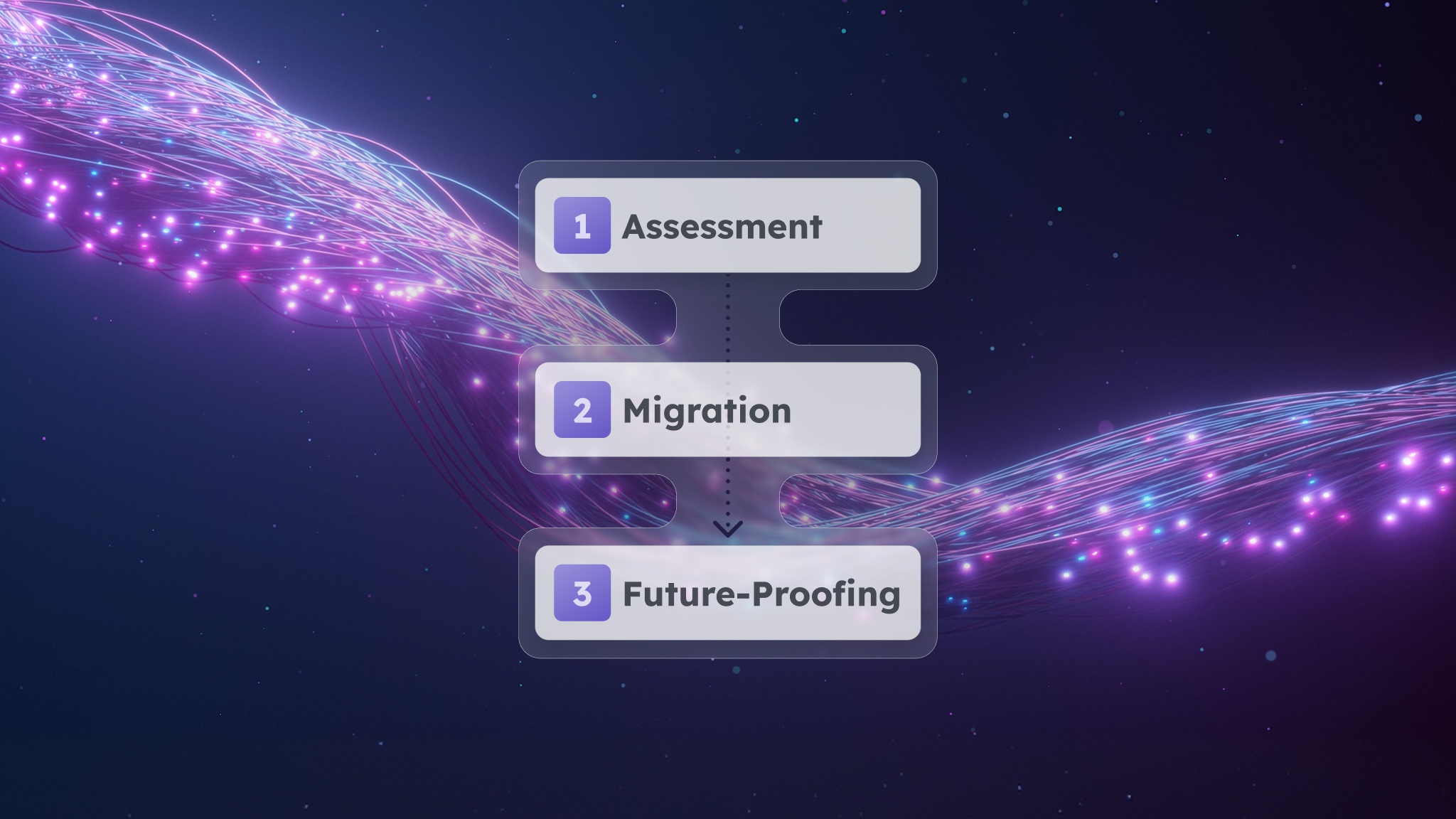
Modern enterprise networks achieve quantum readiness by executing a specific three-step playbook: Assessment, Initial Mitigation, and Long-term Agility. This phased framework mitigates immediate “Harvest Now, Decrypt Later” risks while building native architectural flexibility.
Here’s the step-by-step execution plan:
Step 1: Gain Total Visibility
You can’t protect what you can’t see. Take a thorough inventory of your exposure by mapping your exact Cryptographic Bill of Materials (CBOM) and Quantum Bill of Materials (QBOM). As the market matures, alongside its counterpart in Quantum-capable bad actors, having a defined CBOM and QBOM will go from a recommended step to a mandatory one. Major security and infrastructure players are adding cryptographic discovery capabilities, while more specialized vendors are emerging to help enterprises inventory cryptography, assess quantum exposure, and prioritize migration paths. You don’t have to build the entire visibility layer from scratch, but you do need to own the outcome.
But first, we must answer: What is a CBOM? A CBOM is an inventory of the cryptographic algorithms, protocols, certificates, keys, and libraries used across your environment. It helps security teams understand where cryptography lives and what needs to change.
And what is a QBOM? A QBOM extends that inventory by identifying which systems, data flows, and cryptographic dependencies are exposed to quantum risk. This is effectively your “Quantum Attack Surface”, and it helps your cybersecurity teams prioritize what to protect first.
Once you inventory your exposure, you must identify what cryptography you use, locate where it lives, and pinpoint which systems will be the hardest to refactor.
Audit your existing legacy cryptographic debt. Algorithms like RC4 and MD5 leave you vulnerable to classical threats today, let alone quantum logic tomorrow. Encapsulate, virtualize, or retire these broken protocols. In doing so, take time to review and implement a software-defined environment to limit future cryptographic debt by encouraging a crypto-agile framework.
Locate your long-lived data assets. Crown jewels require immediate post-quantum protection. Trade secrets, financial records, and PII cannot sit unshielded against retrospective harvesting.
Step 2: Buy Time and Reduce Near-Term Risk
Be pragmatic. Start at the outside network edge and work your way inward. Hardening your perimeter boundaries reduces immediate near-term exposure.
Lengthen your existing encryption keys and hashes where possible. This temporarily beefs up legacy ciphers while you transition. Target the threats with the longest shelf life. Actively deploy network defenses to disrupt “harvest now” and “trust now, forge later” (TNFL) update tactics. Hunt for early Federal Information Processing Stands or FIPS-compliant PQC options to embed into your architecture today.
Step 3: Design for Absolute Agility
Avoid the temptation to rip and replace physical infrastructure. Hardware refresh cycles are slow, can be labor-intensive, and incredibly expensive.
Build your defense with software-defined systems. Prioritize API-first, decentralized network architectures. Software adapts to new vulnerabilities at code speed. Choose vendors that provide deep cryptographic transparency. Your technology partners must evolve automatically as compliance mandates shift. Think of the post-quantum world as a threat-rich, but evolving landscape. The days of static cryptography that you can rely on for decades are over.
Build Your Quantum Wall Natively
A security strategy only works if it performs inside real, distributed infrastructure. That’s where ZeroTier Quantum enters the equation.
ZeroTier Quantum is the world’s only end-to-end quantum-secure networking platform. It doesn’t bolt post-quantum cryptography onto aging VPN or TLS setups. Instead, ZeroTier Quantum is a completely separate, memory-safe platform built from the ground up in Rust. ZeroTier Quantum uses a strictly hybrid cryptographic stack, pairing NIST-standardized ML-KEM-1024 post-quantum encryption with classical P-384 ECC. Every node handles identity, encryption, and granular policy enforcement locally.
There’s no single point of failure or centralized trust authority to compromise. Quantum’s zero-trust model fully airgaps the network configuration and authority from the network itself. Quantum network members use a decentralized mechanism to rapidly distribute a configuration signed and minted by post-Quantum credentials, owned by an orchestrator fully airgapped from the network.
ZeroTier Quantum’s secure overlay delivers near-wire throughput performance of up to 10 Gbps. It takes full advantage of hardware acceleration and does this with a 30% smaller footprint than legacy VPN and overlay architectures., Furthermore, ZeroTier Quantum is heavily optimized for both memory and CPU efficiency.
Stop waiting for compliance auditors or adversaries to choose your migration timeline. Start protecting your distributed environments today.
Want to learn more about ZeroTier Quantum? Contact sales today.