

Defending your data takes as much work as the people trying to crack it are willing to put in. In most instances post-quantum cryptography (PQC) isn’t a singular upgrade. It’s not a patch you can apply to one system and be done. And, unlike Y2K, which had a fixed deadline, Q-Day is an indeterminate horizon, making the “harvest now, decrypt later” (HNDL) threat an immediate crisis.
Of course, that risk isn’t isolated to one application, one network, or one team. Over the last two decades, we’ve gotten very comfortable with standard algorithms like Rivest–Shamir–Adleman (RSA) and Elliptic Curve Cryptography (ECC). They worked reliably, so we built entire ecosystems around them. But the world has changed . Today, cryptography is everywhere across the modern enterprise — protecting identities, sessions, keys, data, backups, APIs, devices, tunnels, and vendor platforms. That means every product or platform where cryptography lives needs to be identified, assessed, updated, or reconfigured.
This is why PQC readiness starts with a cryptographic inventory. Knowing where cryptography lives is step one, but an inventory list alone doesn’t tell you what to fix first. To make real progress without slowing operations, you need to triage your risk into four actionable categories.
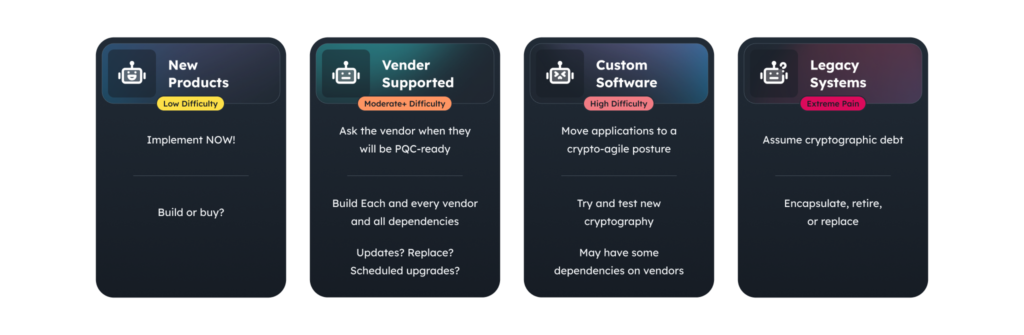
Category 1: New Products
Building or buying something new is the easiest place to start because you don’t have to clean up legacy cryptographic debt first. A clean slate means making quantum-resistant choices today saves you from having to tear things apart tomorrow.
When evaluating PQC for a new build, keep the criteria practical. Look for systems that ship secure out of the box with strong defaults, meaning quantum-safe algorithms are enabled automatically and insecure legacy fallbacks are turned off, a clear path to support NIST post-quantum standards, and explicit cryptographic Service Level Agreements (SLAs). Remember that securing data at rest is only half the job. Network traffic, encrypted tunnels, remote access, and machine-to-machine connections all need that same protection.
Engineering teams usually hit a wall here due to a mismatch in speed. Regulatory frameworks and compliance mandates are putting heavy downward pressure on teams to implement quantum resistance immediately, but hardware refresh cycles still move on multi-year timelines. You can’t wait for new silicon when regulators are asking for compliance now.
This is where software overlays solve the hardware bottleneck. ZeroTier gives you an infrastructure-agnostic, software-defined network platform built from the ground up in Rust. Because it’s API-first and driven by a straightforward Command Line Interface (CLI), your team can embed end-to-end, NIST-compliant quantum security directly into production code. You write the application logic, and let ZeroTier handle the secure transport overlay.
Category 2: Vendor-Supported Systems
Vendor-supported systems present a moderate migration challenge. These are the operational platforms and enterprise infrastructure layers where an external provider dictates the cryptographic primitive implementation. The heavy lifting isn’t necessarily an implementation bottleneck on your end, but managing cryptographic dependencies across a large enterprise footprint can rapidly introduce significant configuration drift.
To avoid configuration drift and ensure your vendors are as prepared as you are, move quickly past the high-level conversations and ask your vendors direct, technical questions:
- Is the infrastructure already quantum-resistant?
- Are configuration changes required on our end?
- Are updates available now, or are they still on a roadmap?
- What specific standards are being supported? Do they align with NIST or something else?
- Will this require a complete hardware replacement or a scheduled software upgrade?
- What is your cryptographic Service Level Agreement (SLA)?
- Who else sits downstream in your cryptographic supply chain?
- How are they being assessed and monitored?
This can get messy quickly. A single SaaS platform might rely on separate external services for identity, key management, hosting, certificates, or secure transport. The vendor itself might be ready, but one of their critical upstream suppliers might not be.
That’s why vendor PQC readiness needs to be tracked like an operational program, not handled as a one-off procurement checkbox. If a vendor’s timeline is lagging, you don’t have to wait for them to catch up. ZeroTier acts as an infrastructure-agnostic, software-defined overlay. You can inject end-to-end quantum security on top of vendor traffic today, bypassing potential deployment challenges or filling in open gaps.
Category 3: Custom Software Systems
Custom software systems can also mean high difficulty because you’re dealing with applications your organization built, inherited, modified, or depends on in ways that may be unique or very specific to your business. You may be dealing with: weak documentation, original developers who are long gone, and brittle architectures that teams are reluctant to touch safely. Furthermore, any downtime on a custom software platform may be costly to the day-to-day operations of your enterprise.
Some systems may need to be refactored by new engineering teams or AI-assisted agents before they can safely support modern cryptographic primitives. Testing is also potentially a challenge. You are not just swapping out an asymmetric algorithm; you are quite potentially breaking assumptions embedded deep inside authentication handshakes, key exchange mechanisms, data storage, and network communication flows. Some linked systems may be impacted by seemingly small changes like packet sizes and expected timing behaviors.
When refactoring a brittle codebase is a non-starter, the smartest move is to decouple network-layer security from application logic.
This is where ZeroTier Quantum shines as a developer-centric, API-first network overlay. It abstracts transport security entirely away from the application layer. Built on an open, highly extensible architecture with deep documentation and CLI tooling, ZeroTier is engineered by developers for developers. Millions of nodes run ZeroTier today — spanning everything from lightweight embedded hardware and gaming rigs up to defense-grade enterprise networks for sectors, such as banking, casino gaming, and national defense.
Instead of spending months refactoring hardcoded crypto libraries inside legacy stacks, simply route application traffic through a ZeroTier secure tunnel. You get immediate FIPS and CNSA 2.0-compliant, end-to-end quantum security for data in transit, without changing a single line of inherited code.
Category 4: Legacy Systems and High-Value Assets (HVAs)
In the quantum era, “legacy” is a broad category spanning everything from aging casino infrastructure and industrial systems to naval vessels, tactical vehicles, radar networks, and aerospace platforms. It also includes High-Value Assets (HVAs) and mission-critical systems like naval vessels, tactical vehicles, radar networks, and aerospace platforms. These platforms remain completely sea- or flight-worthy, but their internal communications, backplanes, and control electronics may be locked into obsolete architectures.
This is where you will likely hit the hardest cryptographic debt. In these operational environments, older protocols like TLS 1.0 and undersized 128-bit keys still run in production, or sit hard-baked into proprietary silicon. A chip can’t be patched, yet these platforms carry critical COMSEC traffic and cannot simply be decommissioned. When opening up bulkheads to replace physical hardware or rewrite decades-old firmware is off the table, encapsulation is your best path forward. Whether you’re dealing with deeply embedded avionics, remote energy grids, or critical industrial control systems (ICS), a physical rip-and-replace is often a logistical non-starter.
Instead of attempting an expensive, high-risk. time-consuming hardware overhaul, you secure the transport path wrapping the asset. Deploying ZeroTier as a software-defined network overlay encapsulates vulnerable traffic inside a peer-to-peer, memory-safe Rust tunnel using a CNSA 2.0-grade cryptographic suite. By placing a lightweight gateway or edge node alongside the platform, you run ZeroTier to establish quantum-resistant communications instantly. You isolate the asset, neutralize HNDL threats, and deliver tactical defense-in-depth without touching a single line of the underlying code or modifying the physical silicon.
Achieving Cryptographic Agility Across All Four Arenas
Whether you’re deploying brand-new products, managing third-party vendor platforms, refactoring custom legacy applications, or encapsulating mission-critical HVAs, the central lesson of the post-quantum transition is clear: Waiting on vendor roadmaps or forcing engineering teams to rewrite fragile internal code is a recipe for operational disaster.
This is why software-defined transport security is so effective. Rather than patching fragile application code or fighting hardware limits, ZeroTier embeds quantum-resilient encryption directly into the protocol layer — encrypting data right at the node before it ever hits the wire.
By decoupling quantum resilience from physical hardware and application logic, ZeroTier delivers immediate cryptographic agility that meets CNSA 2.0 benchmarks out of the box. As global security standards shift, the platform absorbs new cryptographic primitives without requiring a complete infrastructure overhaul.
Quantum risk is no longer a theoretical exercise for future planning committees, it’s a mandate written directly into current federal policy.
With Executive Order 14412 (Securing the Nation Against Advanced Cryptographic Attacks) and the Department of War’s Post Quantum Cryptography Strategy setting firm 2030 and 2031 deadlines for high-impact federal and defense systems, the regulatory clock is ticking. The pressure is global, too. France’s ANSSI has urged organizations to begin migrating critical systems now and says that, after 2030, buying products that don’t support PQC will no longer be reasonable. Germany’s BSI has similarly established a 2030 target for quantum-safe security products protecting classified information. For organizations operating across borders, PQC migration is quickly becoming a matter of when, not if.
With that in mind, this is active modernization work that belongs on your current roadmap. Teams that categorize their areas of cryptographic debt and work effort can think about it and approach the challenges with a strategy and execute systematically. Teams that wait will do much the same work under tight regulatory deadlines with less optionality.
Start with your inventory, then prioritize migration across the four categories outlined above. ZeroTier Quantum can support all four, especially when it comes to new products, legacy software, and legacy systems where rewriting applications or replacing hardware may be impractical. The result? A cryptographic foundation that can adapt as standards, threats, and requirements evolve.
Secure your data in transit before the migration timeline shrinks further. Contact our sales team and build an agile foundation today.