
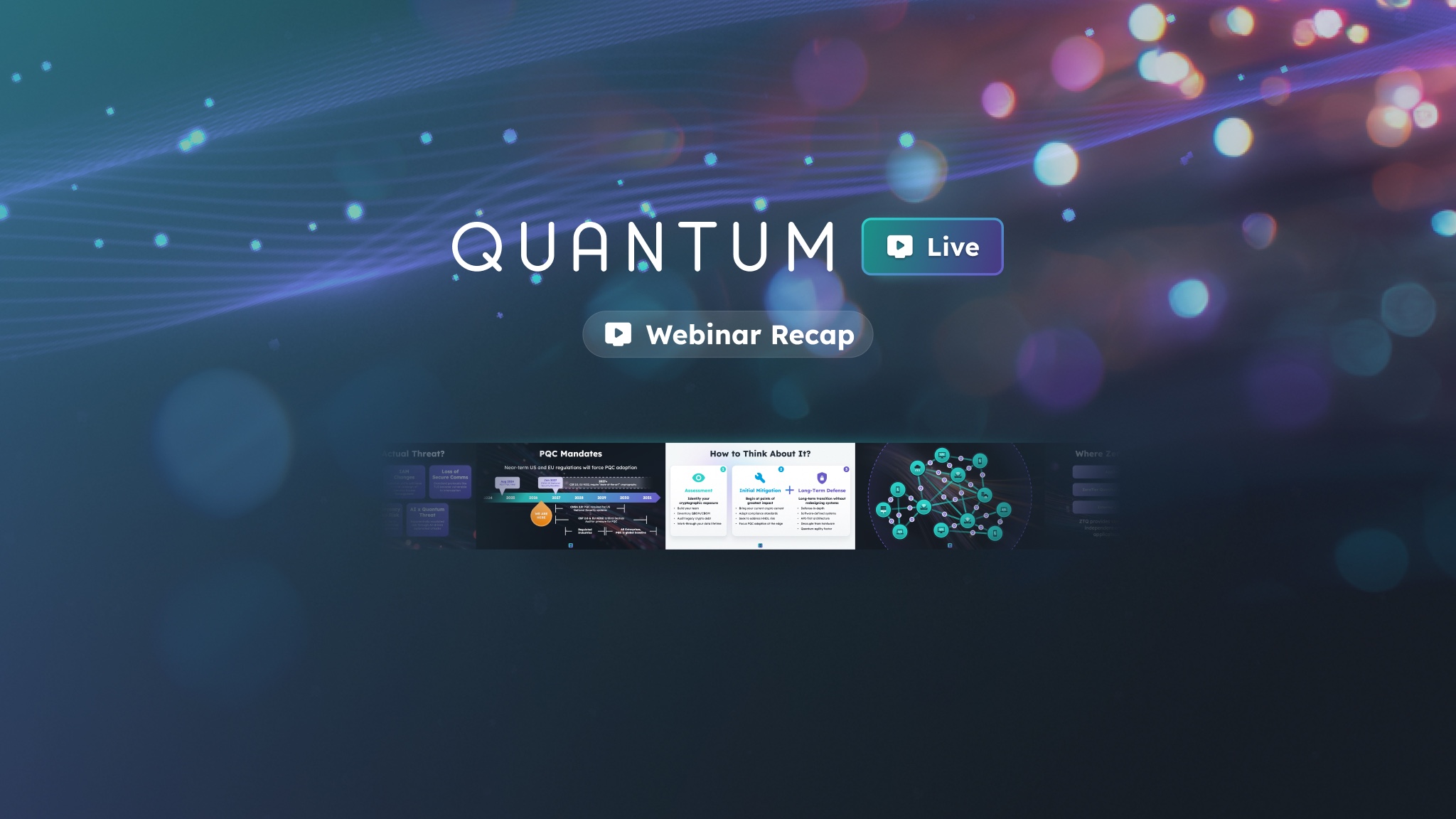
On May 13, ZeroTier hosted Quantum Live!, a practical look at one of the biggest security shifts in decades: the move to post-quantum infrastructure. The session drew hundreds of attendees and focused on what quantum computing changes, why post-quantum cryptography is becoming an operational priority, what enterprises can do now to prepare, and how ZeroTier Quantum helps enterprises prepare now for the quantum-era.
Hosted by ZeroTier CEO Andrew Gault, the session featured Lennon Day-Reynolds, CTO of Tech Integrity Lab, and Angelo Rodriguez, SVP of Global Operations at ZeroTier. Together, they unpacked what’s now being called “Q-Day” — the point where cryptographically relevant quantum computers (CRQCs) become capable of breaking the encryption standards protecting modern systems today.
Why the Quantum Threat Matters Now
The session kicked off with a practical look at what quantum computing actually means for security teams and discussed how advances in qubits, superposition, and quantum-leverage against algorithms like Shor’s are turning once-theoretical concerns into real planning priorities.
The discussion also took a look at “harvest now, decrypt later” attacks, where adversaries collect encrypted data today with the intention of decrypting it once quantum systems mature while touching on “trust now, forge later” identity attacks. The key takeaway was simple: Organizations handling long-lived sensitive data can’t afford to wait for mandates before acting.
The conversation also expanded into the wider blast radius of (5, 6 or 7) key quantum-scale attacks: digital signatures, identity systems, TLS/SSL traffic, hardware security modules, and critical infrastructure all came into focus.
PQC Is No Longer Optional
Quantum risk is not just a cryptography problem anymore. It’s shifting to become a procurement, compliance, and operations problem.
As such, the webinar explored the rapidly evolving compliance landscape around PQC adoption. The discussion also touched on how frameworks like SOC 2 and ISO 27001 are likely to increase pressure on enterprises to prove they’re using modern, quantum-ready cryptography across both their own systems and their vendor ecosystems. Major milestones included NIST’s standardization of post-quantum cryptography and the CNSA 2.0 deadline requiring PQC for new U.S. national security acquisitions by January 2027. The discussion made the takeaway clear: quantum readiness is becoming table stakes across government, finance, healthcare, energy, and other regulated industries.
How to Build a Practical Quantum Defense Strategy
Rather than framing the challenge as an impossible migration effort, Quantum Live! focused on practical next steps enterprises can begin taking immediately.
Outlined during the webinar was a three-step framework for quantum defense: assess cryptographic exposure, begin immediate mitigation efforts, and build a long-term crypto-agile architecture.
The conversation covered everything from inventorying cryptographic assets and identifying long-lived sensitive data to managing legacy systems and reducing cryptographic debt. The session also introduced a temporal approach to quantum risk assessment, encouraging organizations to evaluate how long their data will remain valuable if exposed — whether that’s months, years, or decades — and prioritize their strategy accordingly.
A major theme throughout the webinar was crypto agility — or the ability to adapt quickly as standards, threats, and cryptographic requirements evolve. The discussion emphasized that organizations should avoid locking into rigid hardware cycles or static security architectures that will become difficult to update over time, as well as leveraging an API- and software-based abstraction approach to accelerate and provide long-term durability.
Introducing ZeroTier Quantum
During the final portion of the webinar, the speakers introduced ZeroTier Quantum, the first software-defined end-to-end quantum-secure networking platform.
Built from the ground up in memory-safe Rust with a fully distributed architecture, ZeroTier Quantum was designed specifically to address emerging quantum-scale threats and modern networking complexity. Unlike retrofit approaches that bolt PQC onto legacy systems, ZeroTier Quantum integrates post-quantum cryptography directly into the network layer.
The session also explored how ZeroTier Quantum fits into real-world deployment scenarios through four categories of cryptographic risk and modernization effort:
- Low difficulty – new products
- Moderate difficulty – vendor-supported environments
- High difficulty – custom software
- Extreme pain – legacy infrastructure
For enterprises building new products, the discussion focused on how software-defined networking provides a faster path to post-quantum readiness without hardware refresh cycles. In vendor-supported environments, the webinar addressed the operational complexity of coordinating PQC upgrades across large supplier ecosystems and how software overlays can help reduce vendor lock-in and accelerate adoption timelines.
The session also examined high-difficulty modernization scenarios involving custom software, undocumented architectures, and unsupported applications. In these cases, ZeroTier Quantum can operate either through direct API integration or as a network-layer overlay that abstracts security modernization away from the application itself.
Finally, the session highlighted what the team described as the “extreme pain” category: legacy operational technology, industrial systems, IoT deployments, and critical infrastructure that can’t realistically be ripped and replaced. The speakers emphasized that many enterprises are running decades-old infrastructure with long operational lifecycles, making software-based encapsulation and overlay approaches one of the only viable paths toward post-quantum protection without major downtime or hardware replacement efforts.
The broader message throughout the discussion was that post-quantum migration isn’t a single problem. Different environments require different approaches, and crypto-agile software-defined networking provides organizations with a flexible way to begin addressing quantum risk today.
The bottom line? Enterprises don’t need to rip and replace entire environments to begin improving their post-quantum posture. Software-defined overlays and crypto-agile architectures provide a flexible and immediate path forward today.
Looking Ahead
The webinar concluded with a Q&A covering roadmap plans, migration strategies, hybrid cryptographic models, sovereign deployments, and more. A full FAQ answering all questions from attendees is available now.
Quantum readiness is no longer theoretical. Enterprises are already planning for it, regulators are already signaling it, and attackers are already collecting data that will become vulnerable later. The transition to post-quantum security has started.
If you missed Quantum Live! webinar, watch the full replay. Stay tuned for additional webinars, deep dives, and technical content as we continue rolling out the ZeroTier Quantum platform.
Want to learn more about ZeroTier Quantum? Contact sales today.
Want a deeper breakdown of the terminology? Our complete networking and cybersecurity glossary has you covered.